Share Rolf Malcolm Sinclair's obituary with others.
Invite friends and family to read the obituary and add memories.
Stay updated
We'll notify you when service details or new memories are added.
You're now following this obituary
We'll email you when there are updates.
Select your format and elements to print

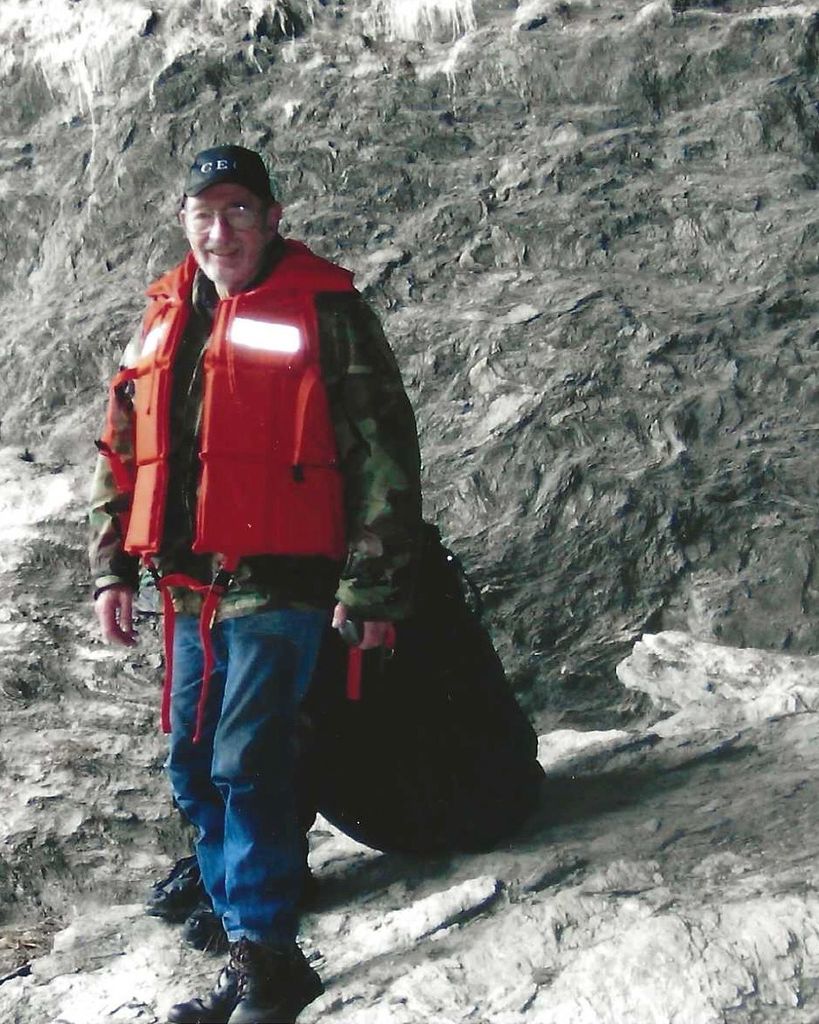


Rolf Malcolm Sinclair
Aug 15, 1929 — Apr 14, 2026
Chevy Chase, Maryland
Born in 1929, Rolf Malcolm Sinclair, Ph.D., lived through the Great Depression and a world war. The Depression briefly broke up his family. His father Nathan lost his job in 1930 and sent his wife Betty and two sons, Rolf & Charles, to live with her family in Shetland until he could find work again. It took over two years and when they returned, Rolf spoke with a distinct Scottish lilt, which he never entirely lost.
A stargazer and amateur astronomer from an early age, Rolf was always fascinated by the heavens. At 16, he went to Caltech to study physics, having decided there were few career prospects for astronomers. A brief detour into the arts (something to do with meeting girls) led him to join the campus dramatic society—until he realized writing might also be a poorly paid career. Fortunately, he soon discovered the rapture of scientific discovery.
One night, while working late on an experiment, he observed a previously unknown property of iron atoms. Realizing he was the first person in the world to know this, he ran to find anyone who might share his excitement. His mathematician friend Abel was awake and understood the enormity of the moment. That night fixed Rolf’s trajectory into a life devoted to scientific research.
After Caltech, Rolf earned his PhD in plasma physics from Rice University and lit out for postwar Europe, working in research labs in Germany and France from 1953-1956. On holiday in London, Rolf met Margaret Lee Andrews, an Australian ballerina with the Royal Ballet. They married and returned to the U.S. to raise a family. They settled in New Jersey—where Rolf worked on the first particle accelerator at Princeton University’s Institute for Advanced Study, Maggie taught the history of dance at Princeton University and Elizabeth and Andrew Caisley were born. Photographs from that time show Rolf staging elaborate prank ‘murder scenes’ in the lab—proof that his dramatic streak never quite faded.
Rolf later took a position as Program Director for Atomic, Molecular and Plasma Physics, allocating research funding, at the National Science Foundation (NSF) in Washington, D.C. The family moved to a three-bedroom whitewashed brick house in the then-solidly working class suburb of Bethesda, Maryland.
Rolf and Maggie were ‘free-range' parents before that was a term. Liz and Caisley roamed the neighbourhood on bikes, explored local woods and streams and hung out with friends. Summers were spent in a rented cottage on Skaket Beach, Cape Cod, the kids exploring cranberry bogs, tidal flats and sandy roads with their summer gang. The Sinclairs were an active family, biking the National Seashore on Cape Cod, hiking and camping on the Appalachian Trail and studying martial arts. Maggie and Rolf were dedicated runners. Rolf and Caisley were active in the Boy Scouts.
Rolf’s brief foray into the arts gave him a lifelong love of theatre, cinema, music and arts. The family spent many evenings at the Folger Library watching Shakespeare, at the Kennedy Center (vale) listening to symphonies and wandering museums on weekends. Both parents read widely and dinner involved long, intense discussions on history, politics, ecology and science.
Rolf’s specialty—plasma physics—was highly regarded in the Soviet Union, as was he. (He spoke seven languages fluently, including Russian and Georgian.) Refusing to take sides in political boycotts, Rolf often said, “Science must always be above politics.” Soviet scientists occasionally visited the Bethesda home for dinner parties, and after consuming more vodka than was good for them, often recited entire Pushkin poems from memory. Rolf and Maggie divorced in 1977 and remained on good terms.
Rolf was active in the American Association for the Advancement of Science (AAAS), helping to organize meetings and speaker panels. He spent a sabbatical year in Santa Fe, working at Los Alamos National Laboratory, and twice deployed to McMurdo Base in Antarctica. As the lead civilian agency supervising U.S. scientific research, the NSF requires program directors to complete one rotation ‘on the ice.’ Rolf remains the only one to have returned a second time. Likely it was his boyhood obsession with Shackleton and the polar explorers that drew him back.
In the mid-1990s, Rolf returned to his first love—astronomy—co-founding, with astronomers George Coyne and Ray White, the Inspiration of Astronomical Phenomenon (INSAP) conferences. What began as a one-off symposium exploring humankind’s fascination with the heavens evolved into a biennial event, now approaching its 30th year, that continues to attract scientists, artists, writers and historians. Rolf also collaborated with artist Anna Sofaer, surveying a prehistoric solstice marker in the American Southwest—a project featured in the documentary The Sun Dagger, narrated by Robert Redford. So Rolf made it into film after all.
Rolf worked at NSF until his retirement in 1998 at age 72. Retirement lasted three months. Claiming boredom, he went to work as a consultant for Centro de Estudios Científicos (CEC) in Chile, advising on glaciology and climate science. Suspicions abound that this was a pretext to get back ‘on the ice,’ since NSF had declined to send him a third time—perhaps assuming no sensible person should want to keep returning to a frozen wasteland. The Chileans, however, let him board navy destroyers and climb glaciers to his heart’s content, fulfilling his boyhood dreams.
Rolf met his current wife, Sarah Richards, in line at the British Museum Library in London. Sarah moved to the U.S., worked at the Smithsonian and accompanied Rolf on icy expeditions to Chile and Patagonia, a family trip through Peru and Bolivia and numerous INSAP and archeo-astronomy conferences across Europe.
Even into his 80s, Rolf hardly slowed down. There was that kayaking expedition in the Arctic Ocean. Although he eventually gave up naval boats and glaciers, he continued working two days a week as a visiting research scholar in the Department of Physics at the University of Maryland, overseeing INSAP meetings, traveling and serving with the American Association for the Advancement of Science (AAAS). He published articles on science, art history and archeoastronomy. He curated an exhibition of solar eclipse paintings at the University of Princeton. After weathering a heart valve replacement, a broken arm and encroaching macular degeneration, Rolf was finally halted by the pandemic and the arrival of his 90th birthday. His mind remained sharp, and the animated late-night conversations continued, fuelled by Sarah’s masterful Ottolenghi dinners and glasses of Rolf’s favourite Georgian red wine.
Rolf survived his older brother Charles and is survived by wife, Sarah, children, Elizabeth and Caisley, granddaughter, Ellyanna, sister-in-law, Gayle Sanders, and numerous cousins, nieces and nephews in the US and UK.
Guestbook
Visits: 284
This site is protected by reCAPTCHA and the
Google Privacy Policy and Terms of Service apply.
Service map data © OpenStreetMap contributors